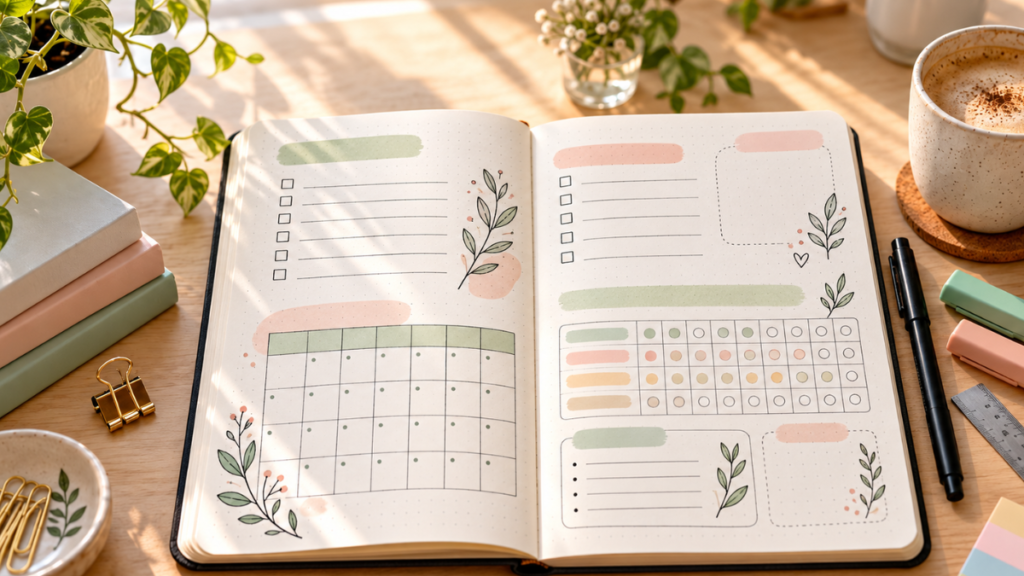
There’s something special about Sunday afternoons. It’s that quiet threshold between what we’re leaving behind and what’s coming next. We often rush through it, caught up in unfinished tasks or even feeling anxious about Monday.
But what if we turned that moment into a journaling ritual to pause, look inward, and actually listen to ourselves again?
Today I want to share a simple but powerful practice with you. Sunday reflections. An intimate space with your notebook to process what you’ve been through, let go of what no longer serves you, and write down fresh intentions for the week ahead.
Why Sunday is the best day for journaling
The pace of the week can disconnect us from what really matters. By the time Sunday evening rolls around, we’re carrying thoughts, emotions, and tasks we never fully processed.
A weekly reflection practice through journaling helps you
- Let go of unnecessary weight before it piles up.
- See more clearly what you actually need.
- Recognize your wins, no matter how small they seem.
- Reset your mental calm so you start Monday with a clear head.
Unlike mental reflection (which tends to loop endlessly), writing by hand forces your brain to organize, get specific, and find closure. That’s what makes Sunday reflections such a powerful tool.

How to create your Sunday thoughts ritual step by step
All you need is 15 to 20 minutes and a notebook. What matters isn’t the technique, but the intention you bring when you sit down to write.
1. Set up your space
Find a quiet corner where you can be uninterrupted. Light a candle, put on some soft music, or simply sit in silence. That small gesture signals to your brain that it’s time to slow down.
2. Start with three weekly reflection questions
Open your journal and answer these honestly.
- What did this week teach me?
- What do I need to let go of before the next one starts?
- What do I want to nurture over the next seven days?
These three questions are the heart of the ritual. They connect you with what was, what needs to go, and what you want to become. Write whatever comes to mind first.
3. Write without filters
There are no style rules or corrections here. Let the words flow exactly as they come. Don’t worry about whether it sounds polished or makes perfect sense. Journaling works precisely when you stop editing and start releasing.
If you feel stuck, try starting with “Right now I feel…” or “This week I discovered that…”. The first sentence is always the hardest. After that, everything flows.
4. Close with an intention for the week
Finish your session with a word, a sentence, or a small commitment. Something that captures how you want to live the next few days.
Here are a few examples.
- “This week I choose calm.”
- “I’m going to say no to what doesn’t add to my life.”
- “I want to be more present.”
Write it somewhere you’ll see it during the week. On the first page of your journal, on a sticky note, on your phone’s lock screen.
Benefits of Sunday thoughts
Making this a weekly practice has effects that go well beyond Sunday.
- You sleep better, because you’re not going to bed with an unprocessed week rattling around in your head.
- Your emotional awareness improves, because you’re giving space to what you feel before it builds up.
- Your self-esteem gets stronger, because every week you’re acknowledging your own growth.
- You start Monday with more clarity and less resistance.
Create your Sunday journal
If you want to take this practice a step further, dedicate an entire notebook to your Sunday thoughts.
Each entry becomes a snapshot of your emotional and mental state at that moment. Over time, you’ll start noticing patterns, progress, and lessons you wouldn’t see any other way. Your Sunday journal becomes a map of your personal growth.

The power of small things
In a world that rewards constant productivity, spending twenty minutes looking inward might seem like a luxury, but it’s the exact opposite.
You don’t need to overhaul your entire routine or fill your schedule with mindfulness techniques. Sometimes the most healing thing is also the simplest. Lighting a candle, writing three lines, noticing how you feel. That small gesture, repeated every Sunday with intention, becomes one of the most powerful self-care practices you can give yourself.
Your inner compass needs space
Throughout the week, so many voices influence us. Work, social media, other people’s expectations. It’s easy to lose sight of what we actually feel or what we truly want. Sunday reflections are your way of coming back to yourself.
Because nobody else can do that reflection for you. Nobody is going to judge what you write in your notebook. It’s a safe space. Just you and your truth.
Frequently asked questions about Sunday thoughts
How much time do I need for my Sunday journaling session?
Between 15 and 20 minutes is plenty. The goal isn’t to write pages and pages, but to give yourself a calm space to reflect on the week. If one Sunday you only have 5 minutes, just write a single answer to one of the three key questions. What matters is keeping the habit going, not the length of each session.
What do I write if my mind goes blank?
This is way more common than you’d think. If you feel stuck, start with a simple sentence like “Right now I feel…” or “The thing that stood out most this week was…”. Just writing that first line unlocks everything else. You can also try describing how you feel physically. Whether you’re tired, full of energy, tense… your body always has something to say.
Do I need a special notebook for journaling?
No. Any notebook works. What matters isn’t the tool, it’s the intention behind it. If having a beautiful journal motivates you, go for it. If not, a simple spiral notebook does the exact same job.
Is it better to write by hand or digitally?
Both options are valid, but writing by hand has real advantages for reflection. It slows your thinking down, forces you to be more intentional with your words, and takes you away from screens, which is exactly what we’re going for in a Sunday ritual. If you prefer typing, try doing it in a distraction-free app with your phone on airplane mode.
Does it always have to be on Sunday?
Sunday is ideal because it sits right at the transition between one week and the next, making it a natural moment to close one chapter and open another. But if your schedule works better on a different day (Friday evening, Monday morning), feel free to adapt it.
Are Sunday thoughts the same as keeping a diary?
Not exactly. A diary tends to be a record of what you do each day. Sunday thoughts are a weekly reflection practice built around questions that help you process emotions, release what you don’t need, and set intentions for the week ahead. It’s more introspective and geared toward personal growth rather than just logging events.
Start this Sunday
All you need is a notebook, a pause, and one honest question. That’s the power of Sunday thoughts. Coming back to yourself, week after week.
I encourage you to try it today. No expectations, no pressure. Just you, your journal, and your calm.
Did you find this guide helpful? Subscribe to the newsletter and every week you’ll get new reflections, prompts, and journaling tools to keep growing from the inside out.