

Find out why I decided to start journaling, what I hope to discover along the way, and how journaling can help you reconnect with yourself. This is the first entry of an honest blog about personal writing.
I’ve been wanting to do this for a while. To sit down, open a blank page, and start telling you why one day I decided I needed to write. Not write to publish a book, or to impress anyone, or to check off some social media challenge.
Write for myself. To understand myself. To stop spinning the same thoughts inside my head over and over and start seeing them outside of it, on paper, where I can look at them with a little more distance.
So here I am. This is the first entry on this blog, and I want to be upfront with you from the start: I don’t have all the answers. I’m not an expert in anything. I’m a regular person who one day sat down with a notebook and a pen and realized something shifted when I put things in writing.
That’s it. It might not sound like much, but it was enough to make me want to share it.
If you’ve made it this far, it’s probably because you’ve felt that same curiosity. That feeling that there’s something inside you that needs to come out, that needs order, that needs space.
So stick around, read this like we’re having coffee together, and let’s see where all of this goes.

The images in this post were generated for illustrative purposes
The day I decided I needed to stop and listen to myself
I’ll be honest with you, there was no epic moment. It wasn’t a revelation in the middle of a trip or a quote I read in a book that flipped my perspective overnight. It was something much more ordinary and much quieter than that.
It was a Tuesday. Or a Wednesday, I can’t quite remember. I was at home after a long day of work, carrying that kind of exhaustion that isn’t just physical. The kind that leaves you feeling hollow inside but with a head full of noise.
A thousand things on my to-do list, a thousand half-finished conversations, a thousand ideas bouncing around without me being able to grab onto any of them.
At some point that night, while I was scrolling through my phone without really seeing anything, I thought: I need to get this out of here. By “here” I meant my head.
I didn’t have a pretty notebook or a plan. I grabbed a loose sheet of paper from the living room table and started writing. No structure, no goal, no worrying about whether it made sense or not. I just wrote whatever I was thinking at that moment. What was worrying me. What was bugging me. What I wanted to do but wasn’t doing.
When I finished, I didn’t feel like I’d discovered the meaning of life or anything like that. But I did feel something: relief. A small but real relief. Like when you open a window in a room that’s been closed for too long and a little fresh air comes in. It doesn’t change everything, but you breathe a little easier.
That was the beginning. A crumpled sheet of paper, a half-dead pen, and the feeling that there was something here worth exploring.
What journaling actually is and why it’s not what you think
Before I go on, I want to talk about this, because I think there’s a lot of confusion out there. If you search “journaling” online you’ll get thousands of images of gorgeous notebooks with hand lettering, washi tape, pages decorated in pastels, and motivational quotes.
That’s fine. If that’s your thing, go for it. But that’s not journaling. Or at least, it’s not only that.
Journaling, in its simplest form, is writing for yourself. Period. It’s grabbing a piece of paper, a notebook, a note on your phone, whatever, and putting into words what you’re carrying inside. Your thoughts, your emotions, your ideas, your doubts, your plans, your fears.
All the stuff that normally keeps circling in your head without you paying it much attention.
It’s not a teenage diary
When I tell people I keep a journal, some of them look at me like I’m fifteen. As if keeping a diary is something you leave behind with adolescence, like friendship bracelets or posters on your bedroom wall.
I get why. The image most people have of a diary is exactly that: “Dear diary, today this happened and then that happened.”
But journaling isn’t about that. It’s not about reporting what you did today like you’re filing a summary. It’s about going deeper, asking yourself questions, observing your patterns, realizing you’ve been writing about the same thing for three weeks straight, and maybe that’s trying to tell you something important.
It’s about using writing as a tool to get to know yourself, not as an activity log.
Some people use prompts, which are questions or phrases that help you get started. Some people write with no direction at all, just whatever comes out. Some people write gratitude lists, or letters they’ll never send, or conversations with themselves. It all counts. What matters is that what you write is yours and it’s honest.
It’s not an obligation or a chore
This is important: journaling doesn’t work if you turn it into just another task on your to-do list. If you sit down to write with the feeling of “I have to do this because it’s time,” it becomes one more burden.
For me, writing in my journal is a space, not an obligation. There are days I write two pages and days I don’t write a word. There are weeks when I write every day and weeks when the notebook stays closed on my nightstand. That’s perfectly fine.
It’s a practice that’s there for when you need it, not something designed to make you feel guilty when you don’t use it.
I think one of the problems with how journaling gets talked about lately is that it’s presented as a habit you have to maintain no matter what, as if missing a day means you’re doing it wrong. That’s not my style. What I’m looking for is something flexible, something that adapts to my life, not the other way around.
Why I chose to start journaling
Okay, I’ve told you the how. Now I want to tell you the why. Because grabbing a sheet of paper and writing on impulse is one thing; deciding you want to turn it into something more consistent is another.
To bring some order to the mess in my head
My mind is a pretty chaotic place. I have ideas nonstop. About things I want to do, about projects that excite me, about conversations I’ve had, about worries that pop up out of nowhere at three in the morning. It all mixes together in there like a soup where you can’t tell the ingredients apart.
Writing helps me separate things. To pull each thought out, set it down somewhere, and look at it with a little perspective. When something stays in your head, it feels massive and confusing.
When you put it in writing, you often realize it wasn’t as big as you thought. Or that it actually was, but now you can see it clearly and decide what to do about it.
Writing doesn’t solve my problems. But it helps me figure out which ones are real and which ones are just noise.
To get to know myself a little better
This might sound a little strange, but I don’t think we know ourselves as well as we assume. We know what we like to eat, what music we listen to, what makes us angry. But there are deeper layers that most of us never really explore.
Why we react a certain way in certain situations. Why it’s so hard for us to say no. Why we feel guilty when we rest. Why we keep repeating patterns we know aren’t good for us. That kind of stuff.
Journaling has been showing me patterns I couldn’t see before. Things that keep coming up in what I write and tell me a lot about what truly matters to me, what hurts me, what I need.
It’s like having an honest conversation with yourself, no filters, no need to look good in front of anyone. Once you’ve been doing it for a while, you start noticing things that used to slip right past you.
To let out what I’m carrying inside without having to explain myself
Sometimes you need to say things you can’t say out loud. Not because they’re terrible, but because you don’t know how to say them, or because there’s no one to say them to right now, or because you need to understand them yourself before sharing them with anyone. The notebook is that space.
You can write whatever you want, however you want, without worrying about being judged. Without having to justify yourself. Without having to explain why you feel the way you feel.
There’s something really freeing about that. About being able to be completely honest in a place where nobody’s going to hold you accountable. Where you don’t have to measure your words or worry about how they sound.
It’s a release, yes, but it’s more than that. It’s a way of making room for yourself in your own life. Of saying: this is what I think, this is what I feel, and I don’t need anyone’s permission to feel it.
To stop living on autopilot
I think a lot of us live on autopilot more than we’d like to admit. We wake up, do what needs to be done, put out the fires, come home exhausted, and repeat the next day.
Journaling forces me, in the best way, to hit pause. To sit with myself and ask how I’m doing today, what I need, what’s weighing on me, what I’m actually in the mood for.
These are simple questions, but when you answer them in writing, taking your time, the answers can catch you off guard.
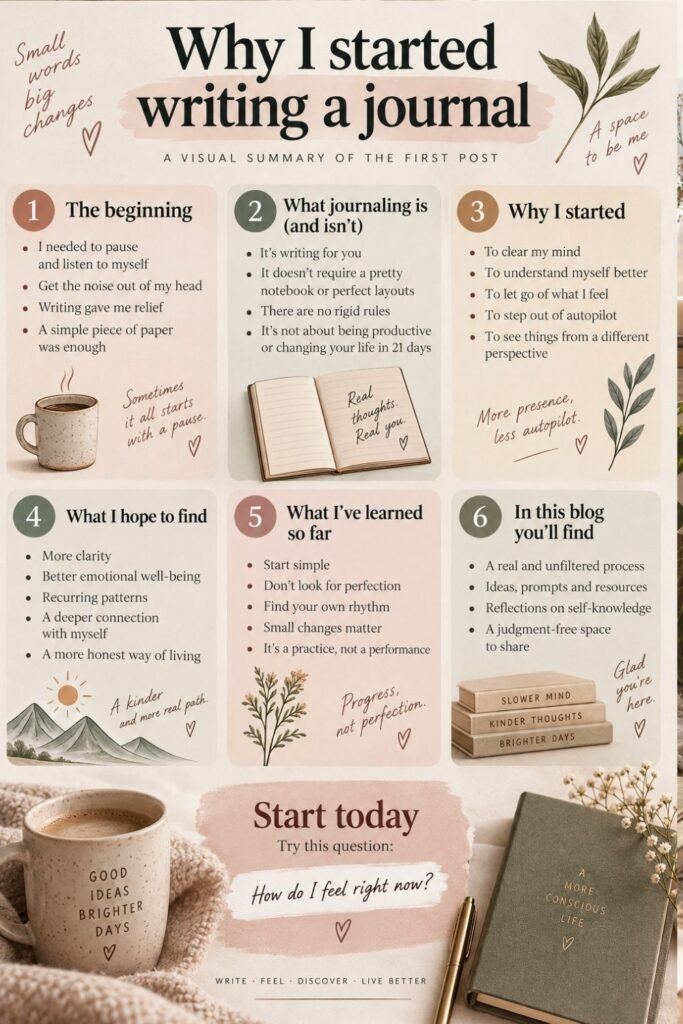
What I hope to find in this process of writing
I’m not going to lie to you. When I first started writing in my journal, I didn’t have a clear goal. I didn’t sit down with a list of objectives or a plan for what I wanted to achieve. I just felt like I needed it, so I started.
But over time, as I kept writing and became more consistent, I started to realize there were things I was searching for, even though I hadn’t put them into words until then.
I think it’s important to talk about this, because we often assume that to do something we need to have the goal crystal clear from the beginning. That’s not always the case.
Sometimes the goal builds itself along the way, as you move forward and start understanding what you truly need. That’s exactly what happened to me with journaling.
I hope to find clarity
Not clarity in the “now I see everything perfectly and know exactly what to do with my life” sense. Not that kind of clarity. More like the clarity of being able to look at a situation and understand how I feel about it.
Of being able to tell the difference between what I want and what I think I should want. Of knowing how to separate my own ideas from the ones I’ve absorbed from the outside without even noticing.
Because that happens a lot. We live surrounded by opinions, expectations, and messages about how we should be and what we should want. Sometimes, when you actually stop to think about it, you realize that a lot of the things you believe you want, you only want them because someone told you to.
Writing helps me make that separation. To clear out some of the noise and hold on to what’s genuinely mine.
I don’t expect it to be a fast or easy process. I know there are layers upon layers, and some things don’t reveal themselves right away. But I trust that little by little, writing honestly, things will settle into place.
I hope to find a way to manage what I feel
I’m not the kind of person who talks about her emotions easily. It’s hard for me. Something happens and I know it’s affecting me, but I can’t name it. Is it anger, is it sadness, is it frustration, is it fear, is it all of the above? When you can’t name something, it’s really hard to deal with it.
Writing is helping me with that. When I sit down to describe what’s going on, even if it comes out clumsy and messy, I start finding the words.
I’ve read that this has to do with how the brain works. That when you put an emotion into words, you activate the rational part, and that helps you regulate what you’re feeling. I’m not sure science explains it in exactly those terms, but I know it works for me.
My first steps with journaling and what I’ve been learning along the way
I want to tell you what my first steps looked like because I think it could help if you’re thinking about starting. I also just like the idea of being transparent about this process from the very beginning.
This isn’t a blog where I’m going to give you the polished, edited version. I’m going to tell you what’s real, with its wins and its stumbles.
At first I had no idea what to write
This is the first thing that happened to me, and I think it happens to a lot of people. You sit there with the notebook open, pen in hand, staring at the blank page with no clue where to start. It’s normal. We’ve spent so long not listening to ourselves that when we finally give ourselves the space to do it, we don’t know what to say.
What worked for me was starting with the most basic thing possible. Writing how I was feeling at that exact moment. Literally that: “Today I feel tired and a little overwhelmed because I have way too many things going on and I don’t know where to begin.”
From there, pulling on that thread, more things started coming out. More things always come out if you give yourself enough time.
Using simple questions also helped when nothing was flowing. Things like: what’s been taking up the most space in my head today, is there something worrying me that I’m not paying attention to, what would I need right now to feel even a little bit better.
What you’ll find on this blog
I want you to know right now what you can expect from this space, because I think that matters. That way you can decide if you want to stick around, if this resonates with you, if what I’m saying here clicks. If it doesn’t, that’s totally okay.
Ideas and resources so you can start writing too
Beyond my own experience, I want to share things that can help you if you’re looking to start, or if you already journal and want to explore new ways of doing it. Writing prompts, different journaling techniques, ways to use writing to work through specific things like anxiety, decision-making, personal goals, or managing your emotions.
Reflections on self-awareness and everyday life
Journaling doesn’t exist in a vacuum. It connects to everything else: how you manage your time, how you relate to other people, how you make decisions, how you treat yourself. So I’m going to write about those things too. About what I observe in my daily life as a result of writing in my journal. About the connections I keep seeing between what I write and how I live.
Not in a self-help guru kind of way, don’t worry. More like a conversation between friends where one says “hey, I just noticed something” and the other goes “you know what, something similar happens to me.” That tone. That level.
Why I decided to share this on a blog
This is a question I asked myself many times before publishing this first post. If journaling is something so personal, so intimate, so mine, why put it on a blog where anyone can read it?
The short answer is: because I wish I’d found something like this when I started.
When I looked up information about journaling in Spanish, I found tons of lists of benefits, tons of articles with catchy titles, tons of theory. But I found very few real voices. Few people sharing their actual experience, with their doubts, their mistakes, their discoveries. I found a lot of content telling me what journaling could do for me, but very little showing me what the real process of doing it looks like.
I thought maybe I could offer that. Not from a place of authority, not from expert knowledge, but from personal experience. From the “I’m in this too, and I’m telling you what I’m finding along the way” perspective.
There’s also something I’ve learned from writing in my journal: sharing what you feel, putting it outside of yourself, gives it a whole different dimension. Thinking something is not the same as writing it, and writing it for yourself is not the same as sharing it with someone. I’m not saying you should share everything, not at all. But I do believe there are things that gain something when you tell them. They become more real, more tangible, more useful. If telling them also happens to help someone going through something similar, then it makes all the sense in the world to do it.
I want this blog to grow little by little, the way a journal grows. No rush, no pressure, one entry at a time.
So if you liked what you read, if something I said resonated with you, or if you’re simply curious, stick around. Subscribe if you can so you don’t miss anything.
Talk to you soon.