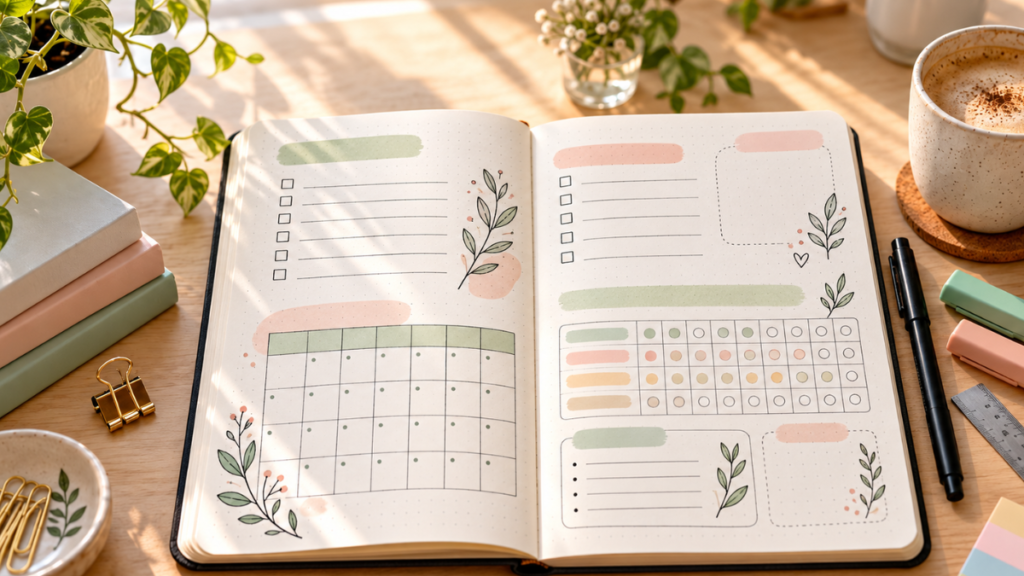
Here’s a complete, beginner-friendly guide to starting your bullet journal from scratch. You’ll learn how to set up your first pages, plan your days, create useful collections, and keep your notebook going without stress, even if you’ve never used one before.
There’s something funny about planners. We start using them with the best intentions, ready to finally get organized, and a few weeks later they end up forgotten in a drawer. It’s not always a lack of motivation or discipline. Sometimes the problem is that we’re trying to fit our lives into a structure that just doesn’t work for us.
I like to think that getting organized should be the opposite of that. It should mean finding a way to track your tasks, ideas, and plans that actually feels comfortable, without overcomplicating things.
Maybe you found this post after scrolling through those gorgeous notebooks on Pinterest or Instagram, the ones with perfectly drawn calendars, beautiful handwriting, and pages full of color. Or maybe you’ve heard about this planning method and you’re wondering if it could actually help you stay on top of things.
Whatever brought you here, I want to show you how to start a bullet journal from scratch, even if you’ve never used one, can’t draw, and have zero interest in spending an hour a day decorating pages.
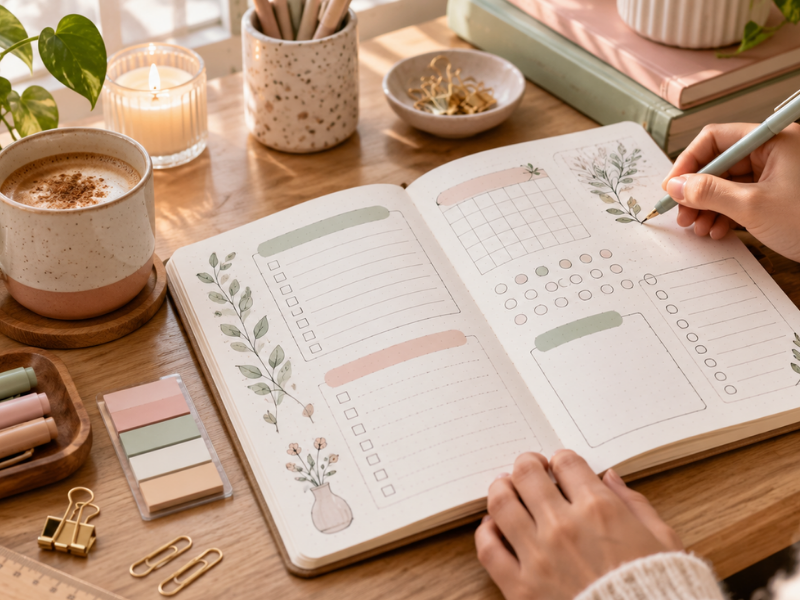
The images in this post were created for illustrative purposes
This post contains affiliate links. Please see the disclosure.
What is a bullet journal, and why is this method worth knowing about
The bullet journal, also known as a BuJo, is a personal organization method created by Ryder Carroll, an American designer who developed a way to log tasks, events, and ideas using a notebook and a system of rapid notation.
These days it’s closely associated with decorating and creative stationery, but its origins are a lot more practical than that. Carroll was looking for a flexible way to organize information, focus on what matters, and review how he was spending his time.
The method first went public in 2013, and over the years it has become an organizational tool used by people with very different needs.
The core idea is to bring everything you need to remember, plan, or work on into a single notebook. Instead of keeping a planner for appointments, multiple to-do lists for tasks, and random scraps of paper for ideas, you can use one unified system that lets you log all of that information and find it when you need it.
But what really sets the bullet journal apart from other planning methods is that you don’t have to set up all your pages in advance. You create them as you need them, so your notebook evolves with you.
Say you start the month with a handful of work tasks, a doctor’s appointment, and a few personal errands. You can jot it all down in your monthly log and then spread the tasks across your days. If you decide to plan a trip halfway through the month, you just open a new page and dedicate as much space as the project needs.
You don’t need to buy a separate planner or try to cram that information into a section that was never designed for it.
The original method is built around four main tools: the index, the future log, the monthly log, and the daily log. On top of those, there’s migration, which means reviewing your pending tasks and deciding which ones still matter. All of these elements are explained in the official Bullet Journal documentation.
The names might sound a little intimidating at first, but you’ll see they’re much simpler to use than they seem.
How a bullet journal is different from a traditional planner
If you’ve ever used a regular planner, you know it typically comes organized by day, week, or month. That structure can be really convenient when it matches how you plan, but it also has its limits.
Some days you need a ton of space to write, and other days you barely have anything to jot down. Sometimes you need a long list for a specific project, and other times you just need to remember one phone call.
In a traditional planner, the space is already decided for you. In a bullet journal, you’re the one who decides how to use it.
That difference lets the notebook adapt to however much information you need to capture. If today you only have three pending tasks, you use a few lines. If tomorrow you need two full pages to map out a project, you can take them without any trouble.
On top of that, you don’t have to start in January or wait until Monday to begin a new plan. You can set up your bullet journal at any time.
I find that especially practical because it gets rid of that feeling of having “missed the boat” when a month is already underway.
What benefits a bullet journal can bring to your life
I don’t want to present the bullet journal as some magic solution that will fix all your organizational problems, because no tool works that way. That said, it can help you get a clearer picture of what you need to do, what’s still pending, and how you want to spend your time.
One of its biggest strengths is that it brings your information into one place. If you’re the kind of person who writes things down in different notebooks, random phone notes, or scraps of paper you can never find again, having a single system can make a real difference.
It can also help you reassess your priorities. When you write down a task and a few days later notice it’s still sitting there, it’s a chance to ask yourself whether you really need to do it, or whether something is holding you back.
You can also use it as a reflection tool. You don’t have to write a full personal diary, but spending a few minutes reviewing your days can help you spot which plans are working, which ones are too ambitious, and what you’d like to change.
If you enjoy stationery, you can add a creative element too. The nice thing is that decorating is completely optional and has nothing to do with whether you’re using the method correctly.
What you need to start your bullet journal from scratch
Before setting up your first pages, let’s talk about supplies. Don’t worry, you don’t need to buy a bunch of stuff.
If you look for inspiration on social media, you’ll find specialty notebooks, markers of different thicknesses, stickers, washi tape, and all kinds of accessories. It’s totally fine to use those if you enjoy them, but you can also get started with a notebook you already own and a pen.
In fact, for your first bullet journal I’d recommend not spending too much. Learn the system first and figure out what supplies feel comfortable. You’ll have plenty of time to upgrade later if you actually need to.
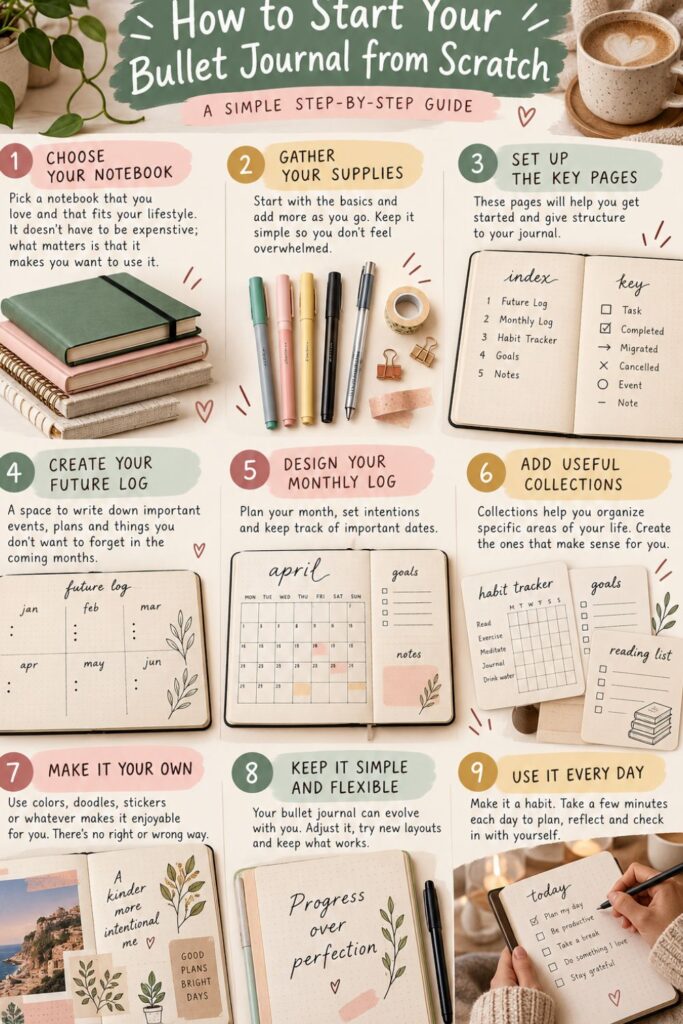
How to pick the right notebook for your first bullet journal
One of your first decisions is choosing the type of notebook. There’s no single right answer, but there are a few things worth considering.
Dot grid notebooks are a popular choice because they let you create tables, lines, and calendars while still giving you freedom to lay things out however you want. The dots work as a guide, but they’re a lot less distracting than traditional grid lines.
If you’d rather just write without worrying about design, a lined notebook works perfectly. If you like to draw or want more open-ended pages, a blank notebook might feel more natural.
Size matters too. An A5 notebook is usually a solid middle ground because it gives you enough room to write while still being easy to carry around. If you need to fit it in a small bag, go with something more compact. If you’ll mainly use it at home, you might prefer something bigger.
As for the paper, it’s worth checking that your pen doesn’t bleed through the pages too much. You don’t need super thick paper if you’re only going to write, but you do want something you can work with comfortably.
I’d prioritize three things. The notebook should lie flat when it’s open, be a practical size, and make you actually want to use it. It doesn’t have to be the most expensive one, and it doesn’t need a fancy cover.
I’d also suggest choosing a notebook you’re not afraid to mess up. This sounds silly, but when we like a notebook too much, it can be hard to start writing in it because we’re scared of making a mistake.
In a bullet journal, you’re going to make mistakes sometimes. You’re going to change dates, cross out tasks, and create pages that don’t turn out the way you wanted. That’s completely normal.
What pens and accessories to use
To get started, a pen that writes well is all you need. If you like to plan your pages out first, you can add a pencil, an eraser, and a small ruler.
Down the road you can add a highlighter for important dates or a colored marker for titles, but you don’t need a full collection of supplies right away.
If you feel like decorating, stickers and washi tape can be great because they let you personalize your pages without needing to draw. You can also use cutouts, small stamps, or any craft supplies you already have on hand.
The point is not to let the prep work become an excuse to put off actually starting. Sometimes we spend so much time hunting for the perfect notebook that we forget why we wanted one in the first place.
How to start your bullet journal step by step
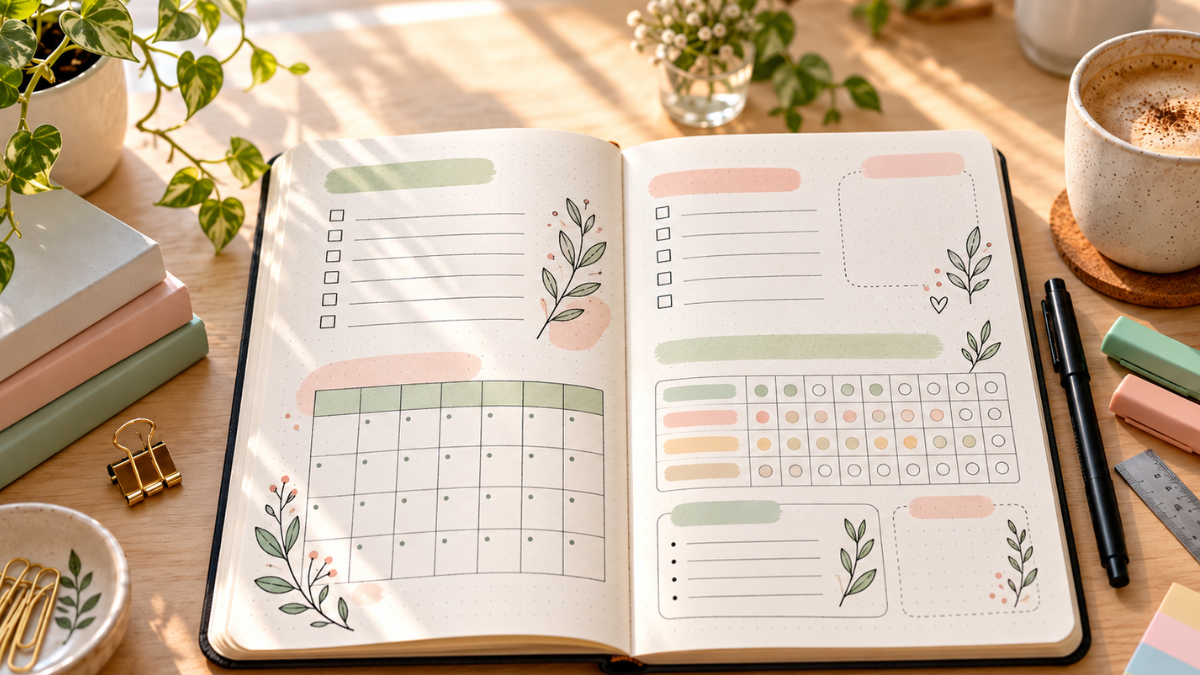
Now that you know what supplies you need, let’s get into the hands-on part. Here’s how to set up your notebook from the very first page, following a structure you can expand on later.
I’m not going to ask you to plan out the entire year or fill in dozens of sections. We’ll start with the basics, and once you’re comfortable with those, we’ll look at how to add more.
Decide what you want to organize with your bullet journal
Before you write a single word, take a few minutes to think about what made you interested in this method in the first place.
Maybe you need to organize your daily tasks because little things are constantly slipping through the cracks. Maybe you want better control over family commitments, or you’re looking for a way to make progress on several personal projects at once.
Or maybe you just want a space to gather your ideas and plan things out at your own pace.
Not everyone needs the same setup, and that’s why it’s important not to build your notebook by copying whatever design you come across.
I’d start by asking myself which parts of my routine are the hardest to keep organized and what information I need to check regularly.
If your main concern is remembering appointments and important dates, the future log and the monthly calendar will probably be your most useful tools. If you juggle a lot of different tasks throughout the day, you’ll likely get the most out of the daily log. If you have several personal projects going on at once, collections might become your go-to feature.
Set up the index of your bullet journal
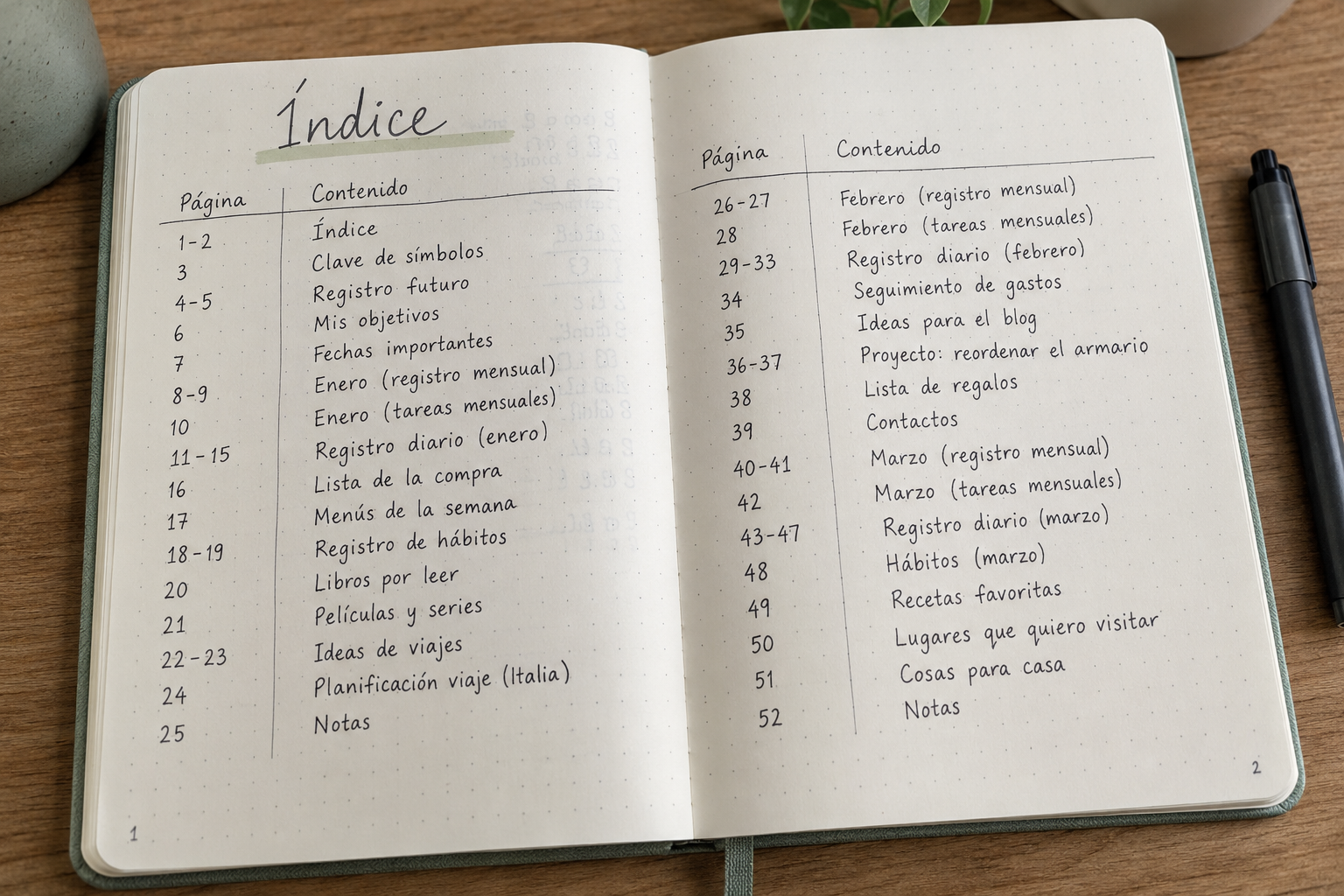
The index is one of those tools that seems unimportant until you’ve been using the notebook for several weeks and need to find a specific piece of information.
Its job is to help you quickly locate the pages dedicated to each topic.
To set it up, reserve the first two pages of your notebook and write the heading “Index.” Then start numbering the pages if your notebook doesn’t come pre-numbered.
You don’t need to number every page right away. You can do it as you go. Every time you create a new section, jot down its name and page number in the index.
For example, if your future log is on pages 3 and 4, you’d write “Future log: 3-4.” If you later dedicate page 18 to a reading list, you’d add “Books to read: 18.”
The nice part is that a section’s pages don’t have to be next to each other. If a book list starts on page 18 and continues months later on page 72, you just note both page numbers in the index.
Create your future log
The future log is where you’ll write down events and commitments that don’t belong to the current month.
Think birthdays, medical checkups, vacations, document renewals, exams, or any date you need to remember a few weeks or months from now.
To set it up, you can reserve two pages and divide them into six sections, one per month. If you’d rather see a bigger picture, you can use four pages to cover all twelve months of the year.
Say you have a car inspection in November, a doctor’s appointment in December, and an insurance renewal in January. Even though you haven’t set up those months yet, you can log the dates in your future log.
When the time comes to plan each month, you’ll check this section and transfer the relevant dates to your monthly log.
Set up your first monthly log
The monthly log is one of the sections you’ll check the most, especially if you have different commitments and tasks to spread across the month.
In the original method, it’s set up across two facing pages. The first one is for the calendar, and the second one is for the month’s pending tasks.
The calendar page doesn’t have to look like a traditional calendar. Ryder Carroll’s approach is to list the days of the month in a column and add the first letter of each weekday next to the number. This way you can quickly see your scheduled events without having to draw a full grid.
What I like about splitting these two pages is that it lets you tell apart the commitments that have a set date from the tasks you can schedule based on availability.
Start using your daily log
The daily log is where the bullet journal really starts to click in practice. This is where you’ll write down the tasks, events, and small ideas that come up throughout the day.
Say you need to answer a few emails in the morning, get groceries, and remember to make a phone call. You can log those tasks using a simple symbol system.
Later in the day, maybe you come up with an idea for a project or remember you need to schedule an appointment. You can write that down too.
Materials: notebook pen washi tape and stickers (optional)
What task migration is and why it’s one of the most useful parts of the bullet journal
So far we’ve talked about writing tasks, organizing dates, and saving ideas. But there’s a part of the method that I think is especially interesting and often gets overlooked. It’s called migration.
Migrating a task means reviewing it and deciding whether it still needs to get done. If it’s still important, you move it to another log. If it no longer makes sense, you drop it.
The key is that you shouldn’t just automatically copy everything that’s still pending. Say you’ve written down during the month that you want to organize a closet, look into a course, review some paperwork, and start a personal project.
When the end of the month rolls around, you realize you only got through a few of those. You could copy the rest over without thinking twice, but the method asks you to do something more intentional. Ask yourself which ones actually deserve to stay on your list.
Migration lets you make decisions instead of piling up obligations indefinitely.
How to do a monthly review of your tasks
At the end of the month, go back through the pages you’ve used and look at which tasks are still open. Check which ones you’ve completed, which ones need to move to next month, and which ones you can let go.
There’s no point in keeping a task on your list just because you wrote it down three weeks ago.
What to put in a bullet journal. Collection ideas you can use
Once you have the basic structure in place, you get to the most personal part of the bullet journal: collections.
A collection is a page, or group of pages, dedicated to a specific topic. It can be used to organize a project, keep a list, track information, or follow up on something that interests you.
I’d start with the ones that respond to something real in your life. If you don’t usually track what you’re reading, a fancy book-rating page probably won’t be useful. If you never plan weekly menus, you don’t have to start doing it just because you saw a pretty design for it.
Decoration can be inspiring, but usefulness should be what guides your choices about which sections to create.
Reading list and finished books collection
If you love reading, you can dedicate one page to books you’re interested in and another to the ones you’ve finished.
You don’t need to draw a bookshelf or use a complicated table. You can write the titles, the authors, and if you feel like it, a short rating. You can also include recommendations from friends or books you discovered while browsing a bookstore.
I think it’s worth separating the books you truly want to read from the ones that just caught your eye. That way the list doesn’t turn into a chore.
Grocery and meal planning collection
Another really practical idea is using a collection to organize your weekly groceries or meals.
If you like to plan meals ahead of time, you can dedicate a page to the week’s dinners and add the ingredients you need to buy. You can also put together a list of go-to recipes for those days when you have no idea what to make.
Spending tracker and personal budget collection
If you want more control over certain expenses, you can set up a page to log the money you spend in a specific category. For example, maybe you want to track entertainment spending, personal shopping, or the budget for an upcoming trip.
You can write down the date, what it was for, and how much you spent. Then at the end of the month, you review the total and decide whether you need to adjust anything.
Personal projects collection
Your bullet journal can also help you organize projects that involve multiple steps.
Say you want to redo a room, plan a celebration, or kick off a small creative project. Instead of writing one massive task, you can break it into smaller, more specific actions and jot down everything you need to remember.
For example, if you’re planning a family gathering, you can pull together the date, the budget, the guest list, the shopping list, and the different things you need to take care of.
A collection can take up as many pages as you need. If you run out of space, you just continue on the next available page and add the reference to your index.
Creative project ideas collection
Not every collection has to be about obligations. If you enjoy writing, drawing, cooking, decorating, or working on your own projects, you can create a space to save the ideas that pop up when you least expect them.
For example, if you have a blog, you can jot down potential topics for future posts. If you enjoy home decor, you can note changes you’d like to make around the house or materials you want to try.
The idea is to have a place to capture those thoughts without needing to decide right away when you’ll act on them.
Sometimes an idea can sit on a list for weeks before it turns into a project, and that’s perfectly fine.
Common mistakes when starting a bullet journal and how to avoid them
Even though the system is pretty simple, there are a few mistakes that can make it harder to maintain than it needs to be.
One of the most common is trying to set up too many pages right from the start.
When you discover everything a bullet journal can do, it’s tempting to create a monthly plan, a weekly plan, a daily log, several habit trackers, book lists, expense logs, and a ton of other collections.
The problem is that each of those pages needs some level of upkeep. If you’re not yet sure how you’ll use your notebook, you might end up spending more time updating sections than actually organizing what matters.
I’d start with the basic structure and add collections gradually.
Another common mistake is copying layouts without thinking about whether they actually fit your routine. A weekly spread might look great, but it probably won’t work for you if your schedule changes constantly.
Don’t turn your bullet journal into an endless list of things you should be doing.
If every time you open it you’re staring at dozens of unfinished tasks, you might need to rethink your priorities and cut down on the number of commitments you’re trying to take on.
The goal of getting organized shouldn’t be to fill every available slot.
How to set up your first bullet journal in one afternoon without stressing out
After all these explanations, you might be wondering where exactly to begin. My suggestion is to set aside a quiet afternoon and only prepare the essential pages.
Start with whatever notebook you have available and reserve the first few pages for the index. Then set up your future log with the upcoming months. Write down the birthdays, appointments, and commitments you already know about. After that, dedicate two pages to your monthly plan. On one, you can record important dates, and on the other, the tasks you’d like to get done.
Once that’s ready, open a new page and write today’s date. Think about the tasks you need to tackle, the events you want to remember, and the ideas you don’t want to lose.
That’s it. Your bullet journal is ready to go.
During the first week, focus on getting used to logging information and checking it when you need it. After that, you can start thinking about which extra sections might help.
Maybe you’ll realize you need a recurring grocery list, a project collection, or a space to save your ideas. The great thing is that you won’t have to reorganize the whole notebook. You’ll just use the next blank page.
Frequently asked questions about starting a bullet journal from scratch
What’s the first thing I should put in my bullet journal?
The best place to start is with the index, the future log, and your plan for the current month. After that you can add the daily log and begin recording your tasks, events, and ideas. Once you’ve been using it for a while, you can build out the collections that actually make sense for you.
Can I start a bullet journal in the middle of the year?
Absolutely. One of the best things about this system is that it doesn’t depend on a pre-made calendar. You can start in January, October, or any other month. You don’t need to wait until Monday or the first of the month either. Just set up the pages for wherever you are right now and go from there.
What type of notebook is best for beginners?
A dot grid A5 notebook is usually a comfortable choice because it lets you create different layouts and is easy to carry. That said, you can also use a graph paper notebook, a lined one, or a blank one. What matters most is that it feels comfortable to write in and take with you when you need it.
Do I need to know how to draw to make a bullet journal?
You don’t need to know how to draw or have especially nice handwriting. The original method is based on quick entries and a simple structure. You can set up every page using nothing but a pen.
How much time should I spend on it each day?
There’s no set amount of time required. Some people only need a few minutes to check their tasks, while others prefer to spend more time writing or preparing new pages.
What’s the difference between a bullet journal and a personal diary?
Even though both use a notebook, they serve different purposes. A personal diary typically focuses on writing about experiences, thoughts, and emotions. A bullet journal combines planning, tasks, events, notes, and reviews. That doesn’t mean you can’t include personal reflections. You can absolutely dedicate pages to writing about your day if that’s helpful, but it’s not required.
Is a minimalist bullet journal better or a creative one?
That depends on your preferences. If you’re looking for a quick organizational tool, a minimalist design will probably feel most comfortable. If you enjoy drawing and decorating, you can bring in that creative side. You can also mix both styles, keeping your daily planning pages simple and going all out on the collections you feel like decorating.
Can I use a bullet journal to track my habits?
Yes. You can set up a habit tracker to monitor specific activities like reading, studying, or working on a personal project.
Can I combine my bullet journal with a digital planner?
Yes, and it can actually be a great option if you already use reminders or calendar apps on your phone. You can keep important appointments in an app and use the notebook for organizing tasks, projects, and ideas. The key is to give each tool a clear purpose so you’re not duplicating information for no reason.
It’s totally normal to want to try different layouts, colors, and collections at first. You’ll also discover that some ideas that seemed amazing don’t work that well in your actual routine.
Maybe you start with a monthly log and after a few weeks realize you need a weekly spread instead. Or maybe you set up several collections and end up only using two of them.
All of that is part of the process of finding your own way of getting organized. I’d pay more attention to how it feels to use the notebook than to how the pages look. If opening it helps you see what’s pending and plan your next few days, you’re onto something useful.
The beautiful thing about building your own bullet journal is that you get to create a system that fits your life, your responsibilities, and the way you like to organize.
Have you ever tried a bullet journal before, or are you thinking about starting your first one? Do you prefer simple notebooks with practical lists and calendars, or do you like adding colors and little decorative touches?
Tell me in the comments, because I’d love to hear what kind of pages you’d like to set up and what questions you have before getting started.
I’m sure that together we can put together some simple ideas to help other people find their own way of staying organized.